The mockumentary style is very interesting. I actually have written about it a couple of times now. They’ve been becoming more and more common with many very popular examples these days. There’s the Office, but also Modern Family, Arrested Development, Parks and Recreation, and 7 Days in Hell. There has even been some pretty interesting kids shows like The Naked Brothers Band or the Total Drama Series. They function in different ways, the Office and Parks and Rec provide a sort of a western “slice of life” show. The shows take the viewer into the everyday, if out of the ordinary, lives of these coworkers. Modern Family is similar in that it follows the life of an unconventional family, but still gives you the perspective of each character thought the reality TV style “confession cameras.” Meanwhile 7 Days in Hell and Arrested Development simulate actual documentaries. It all provides a different framing for comedy than the standard sitcom. Rather than a straightforward story telling, the mockumentary allows for that story, but with the ability to insert those interview like portions that give an extra chance for jokes and the chance to give characters real opinions.
The popularity of these shows coincides with the rise of popularity of actual reality shows. Modern Family came just after Keeping Up with the Kardashians, another show about the daily lives of a family. The Total Drama series, a made up competition series pitting teens against each other in ridiculously dangerous challenges, came out while Survivor was still culturally relevant. People seem to enjoy these shows that take everything that is inherently incongruous with these cultural phenomenons and dial it up to make it even more ridiculous.
Wednesday, November 30, 2016

Tuesday, November 15, 2016
I'd Like to Cutaway From Whatever Channel Family Guy is On.
The cutaway gag is certainly a staple of the show Family Guy. They do allow the writers to add in another joke, but is it a good one? On the whole, they really don’t fit in with the rest of the scenes they are in. They’re barely ever tied into the scene itself, almost always falling back on “This is worse than the time…” It’s barely enough to prevent what they call a “Big Lipped Alligator Moment.” Where a scene is included but has no real impact on the plot without even being a distraction enough to be a red herring. Interruptions like those are funny free standing, but in a scene, they interrupt what's really going on. Constant random cutaways can come across as sloppy and cause the show to become tiresome.
The reason the writers for this show use them so often is because they give them the chance to throw in a quick joke that they couldn’t sustain in a whole episode without having it make any difference in the plot of the episode. It’s the same way Stewie works a large majority of the time, making comments and acting out in ways that only really Brian ever notices. As such the writers are able to put in those jokes without having to come up with the reactions or results of the actions.
Perhaps part of the humor is found in these outrageous other lives the characters are apparently living off screen. American Dad, which in my opinion is the better Seth Macfarlane does the same thing, most of the time through Roger who seems to live multiple lives simultaneously. With Roger, though, this is worked into the plot, at times being the center of an episode, and even being the source of ridicule for the way the show is constantly using it as an out, as in the scene where they take the horse to a therapist and the following happens (couldn’t find a copy online that didn’t seem like it was filmed on a Samsung Juke):
Stan: Everything depends on this horse.
Roger:Luckily, I know a guy who might be able to help us. Let's just pray that for once, when we get there, he doesn't turn out to be me.
_______
Roger: Aw, crap.
Roger in a wig: Can I help you?
Stan: I had an appointment
with the horse whisperer.
Roger in a wig: Oh, yes, he'll be right with you.
Roger: Thank God I'm just his secretary.
Roger in a wig:I'm an associate.
Self parody is always appreciated. It’s nice to see the show realize its own shortcomings and bad habits. It’s similar to when Monty Python ended a sketch with policeman after policeman arresting each other for overusing the same trick of using a policeman to end a sketch. The fact that the writers are aware of the habit is funny, but so is the fact that within the context of the show, Roger realizes that he’s crazy and is frankly upset that his habit inconveniences himself more than anyone else. There’s a point at which a bit like the cutaway gags or Roger’s characters become overused and lazy, but they have the potential to once again be funny. The show just has to double down and mock its own use of the trick.
The reason the writers for this show use them so often is because they give them the chance to throw in a quick joke that they couldn’t sustain in a whole episode without having it make any difference in the plot of the episode. It’s the same way Stewie works a large majority of the time, making comments and acting out in ways that only really Brian ever notices. As such the writers are able to put in those jokes without having to come up with the reactions or results of the actions.
Perhaps part of the humor is found in these outrageous other lives the characters are apparently living off screen. American Dad, which in my opinion is the better Seth Macfarlane does the same thing, most of the time through Roger who seems to live multiple lives simultaneously. With Roger, though, this is worked into the plot, at times being the center of an episode, and even being the source of ridicule for the way the show is constantly using it as an out, as in the scene where they take the horse to a therapist and the following happens (couldn’t find a copy online that didn’t seem like it was filmed on a Samsung Juke):
Stan: Everything depends on this horse.
Roger:Luckily, I know a guy who might be able to help us. Let's just pray that for once, when we get there, he doesn't turn out to be me.
_______
Roger: Aw, crap.
Roger in a wig: Can I help you?
Stan: I had an appointment
with the horse whisperer.
Roger in a wig: Oh, yes, he'll be right with you.
Roger: Thank God I'm just his secretary.
Roger in a wig:I'm an associate.
Self parody is always appreciated. It’s nice to see the show realize its own shortcomings and bad habits. It’s similar to when Monty Python ended a sketch with policeman after policeman arresting each other for overusing the same trick of using a policeman to end a sketch. The fact that the writers are aware of the habit is funny, but so is the fact that within the context of the show, Roger realizes that he’s crazy and is frankly upset that his habit inconveniences himself more than anyone else. There’s a point at which a bit like the cutaway gags or Roger’s characters become overused and lazy, but they have the potential to once again be funny. The show just has to double down and mock its own use of the trick.
Wednesday, November 9, 2016
Please Laugh - JEB

I actually did my essay more or less on this topic. I found it very interesting the way people see the laugh track. (If you’re curious here’s the article I used, but if it doesn’t work it’s “Laughing Together” on Academic Search Premier http://search.ebscohost.com.libproxy.furman.edu/login.aspx?direct=true&db=aph&AN=66469859&site=ehost-live) It’s basically a focus group that watches sitcoms with and without a laugh track and then talks about what their perception of the laugh track is. Essentially, they were all fairly aware of the laugh track in watching the show, and all but two really disliked the laugh track believing it was almost condescending, telling them when to laugh. And yet, the average sitcom still feels the need to use it, and those shows are still popular. As much as people don’t like the laugh track in theory, they in practice, it doesn’t seem as though they mind it all that much. If anything, it seems to really help shows reach the mainstream.
Why is that though? Everyone seems so opposed to it, but at least on some level, they must like or rely on it. Two of the people in the study openly liked it. One of them said it turned it into a group experience which I found interesting. Humans are social creatures so it would make sense that the impression of having multiple people there would make a difference. It’s sort of similar to the screens in Fahrenheit 451 which served the purpose of giving the feeling of being surrounded by other people, providing a sense of society without being social. On the other hand though, another person in the group argued that it served simply as a cue to the jokes. It’s like someone walking you through the humor. Though this is precisely why some don’t like it, maybe they still rely on and appreciate it. Lots of other shows that don't use a laugh track still will have some way of pointing moments of comedy out with moments of silence as characters in the show react or with complete breaks from the scene in shows like Modern Family or the Office with the interviews or the narrator in Arrested Development. It's a function that producers really seem to find necessary. 
Thursday, October 27, 2016
The Whitest Last Paragraph U'Know (anyone know why it does this, I can't fix it)
A joke is a joke, but you should never underestimate the comedic power of the reaction. It can be used to enhance the humor already employed. Incongruity is enhanced by other people reacting to it. One of the classic YouTube accounts of our era (aka like middle school), The Whitest Kids U’Know base a lot of their comedy in creating these bizarre situations and then having someone else present, not a part of the craziness, but just bearing witness. The best way to explain it is through example.
That scene is a perfect example of the first usage. Having a person reacting to an incongruity to provide an avatar for the viewers frustrations and give the incongruous situation or oblivious person someone to bounce their incoherent thoughts off of. In this case we have a man pitching his idea for a soda commercial to a board of executives. His idea for “the Grapist” character is of course ridiculous, and watching a full grown man in a grape costume chasing kids around isn’t what you’d expect from a commercial marketing a children’s beverage. But then having to watch the man try to justify his choice extends the scene, giving us the chance to revel in the incongruity. Of course he is completely oblivious to the main problem. The only one of the executives really seems to be seeing what's wrong with that scenario. He struggles to try and get the others to see what's wrong. He’s a voice of reason that highlights everything wrong with what’s happening. Somehow he’s the crazy one and gets called out for seeing such inappropriate things in the harmless commercial. His crisis as he eventually approves the commercial can be just as funny as the commercial itself.
This video takes a different approach to the reactions, here we have a man who also has some serious problems with the story he’s being told, but just out of social pressure, he’s trying his best not to react in the way one should. It’s an everyday scenario, two old college friends see each other out in public and catch up a little bit. However, here, one of them is holding a gallon of PCP. That comes as a bit of a shock to the other. He does his best not to show it though, but his panic continues to grow as the story continues. He’s just too polite and never actually addresses that concern. It’s still a lot like the last video, though. He is able to raise questions about all of the absurdities of the story leading people to where the jokes are. In my case, it didn’t even register at the time that PCP wouldn’t be liquid until he brought it up. We just get to watch him squirm in this situation, trying to get through the interaction without freaking out, while still being sickened but curious. Just to add insult to this, the other guy has a good job and is more successful.
Whitest Kids U’Know really seem to have a formula of their own. They create a ridiculous scenario, usually from an everyday interaction, and then insert one sane person to deal with it all. Their isolation frustrates them which is funny in its own right, but it's also used to highlight the insanity around them. They’re the benchmark for crazy.
This scene gives us the opposite scenario, instead having everyone just sort of accept the incongruity. Here, we’re the sane one, left out, questioning what’s going on . First we watch the teacher torment that poor kid whose mother died, with the rest of the kids playing along. Then we watch the other kid celebrate when he finds out he doesn’t have any parents. Neither of these seem like the right reaction in the scenario. No one reacts that way, though. The kid just gets to go wild. When one man asks him why he’s hitting a building with a hammer and he responds because his parents are dead the man is like, “curses he’s right”. It escalates the scenarios each time with reactions seeming more and more wrong. It’s frustrating, but at the same time it’s funny because it’s so ridiculous. As soon as his parents die no rules apply to this kid, even apparently those of space and time.
Tuesday, October 25, 2016
I Don't Make the Comedy, I Just Know It
I believe I am in the minority here, but I didn’t enjoy either of these sketches all that much. That could be largely because they’ve already been done. Abbott and Costello did them first but I’m seeing them do it second. The baseball scene was copied for the Kids in the Hall sketch, “McCillicutty and Green.” It was, of course, killed by this scene. Having the joke cannibalized for the sake of that scene crushed any amount of humor in that joke. Being a mathlete back in middle school I was exposed to the same sort of tricks as in the second video a lot. I had a teacher who always did it to stump the students, but I had her for four different classes, so it got old.
Following a formula for comedy doesn’t sound good. This class has shown us it's hard to boil it down into anything so simple. I think there is a general framework to sketches. Introduce a scenario, usually a weird one or one that is slightly incongruous. Build upon that idea with examples, usually three, the golden number of comedy. To end it, wrap up with one final joke that ties back to a joke or comment previously made in the sketch. That’s the formula that seems to work. SNL especially can be seen following this pattern in its skits, like “Jeopardy” that typically only goes through like three questions before Alex Trebek loses control, or . One of my favorites, “Meet Your Second Wife”, also does this. https://youtu.be/MJEAGd1bQuc It starts with a ridiculous concept for a game show, gives three contestants with increasingly young wives (though the third one trips us up by starting with the older woman), and then wraps it up by giving everyone a new kayak, expanding on what would lead to the second contestant's wife's death.
While some don’t like this rigid, predictable structure, I think it can have benefits. The three examples are enough to establish a pattern, with the third one either taking the pattern farther, or completely breaking from it to create incongruity. Then the joke at the end leaves them laughing, and the reference to a previous portion of the sketch just leaves them laughing harder as another layer is added to what was already funny. As I blogged about earlier with the “Debbie Downer” sketch. Being able to expect a joke, anticipating it and then having that realized is an effective comedic device. Whether the audience gets exactly what they’re looking for or a slight spin on it, they’re still delighted by a character’s compulsion or a remarkable coincidence.
To summarize repeating a joke is disappointing. Even if the audience does find it funny again, it’s rarely as funny as it was the first time. However, following a similar structure doesn’t repeat the jokes, it just delivers the jokes in a familiar, easily understood way.
Tuesday, October 18, 2016
Why did the Maya Rudolph cross the road?
This is one of the most infamous clips in the entire movie. I find it extremely funny. I think I'm able to do this because the movie never actually confronts us with the poop itself, just a little throw up. What we are treated to is the characters pain and struggle as they sweat it out in the bathroom. They try to keep it together as best they can but they all fall apart. All the while the real mess is safely concealed under lots of fabric.
One of the best parts of this scene, though, is the contrast between the two settings of this scene. There is the refined dress shop, filled with dangerously white carpet. The bathroom itself is just as refined, but the scene inside of it quickly devolves. The movie cuts between the two of them making the humor in either even funnier. The bathroom is full of women screaming at each other as they destroy it. It's loud and chaotic. Outside, in the store, Annie is doing her best to maintain composure and Helen, who didn't eat the meat, is completely fine. We laugh as Helen torments the sweaty Annie by talking about her distress and even getting her to eat. The two of them are basically whispering with refined piano music playing in the background. It's quiet and sophisticated. Going from the quiet of the store makes the turmoil of the bathroom more jarring. Then going from that back to Annie's quiet suffering makes it more fun to watch the pain in her eye.
I don't believe trying to relate Mr. Hankey to the Bridesmaids scene would really work. Their humor is different, they're mainly just tied together by the presence of poop. Mr. Hankey is about this crazy character and what he represents. South Park makes him a Santa like character. On the other hand, Bridesmaids focuses more on the behavior of the characters as they perform this normal act, taken to an extreme by the questionable Brazilian food. Poop humor is a thing, but not all humor involving poop is necessarily poop humor.
One of the best parts of this scene, though, is the contrast between the two settings of this scene. There is the refined dress shop, filled with dangerously white carpet. The bathroom itself is just as refined, but the scene inside of it quickly devolves. The movie cuts between the two of them making the humor in either even funnier. The bathroom is full of women screaming at each other as they destroy it. It's loud and chaotic. Outside, in the store, Annie is doing her best to maintain composure and Helen, who didn't eat the meat, is completely fine. We laugh as Helen torments the sweaty Annie by talking about her distress and even getting her to eat. The two of them are basically whispering with refined piano music playing in the background. It's quiet and sophisticated. Going from the quiet of the store makes the turmoil of the bathroom more jarring. Then going from that back to Annie's quiet suffering makes it more fun to watch the pain in her eye.
I don't believe trying to relate Mr. Hankey to the Bridesmaids scene would really work. Their humor is different, they're mainly just tied together by the presence of poop. Mr. Hankey is about this crazy character and what he represents. South Park makes him a Santa like character. On the other hand, Bridesmaids focuses more on the behavior of the characters as they perform this normal act, taken to an extreme by the questionable Brazilian food. Poop humor is a thing, but not all humor involving poop is necessarily poop humor.
Tuesday, October 11, 2016
Was Feline AIDs Ever Not Funny Though?
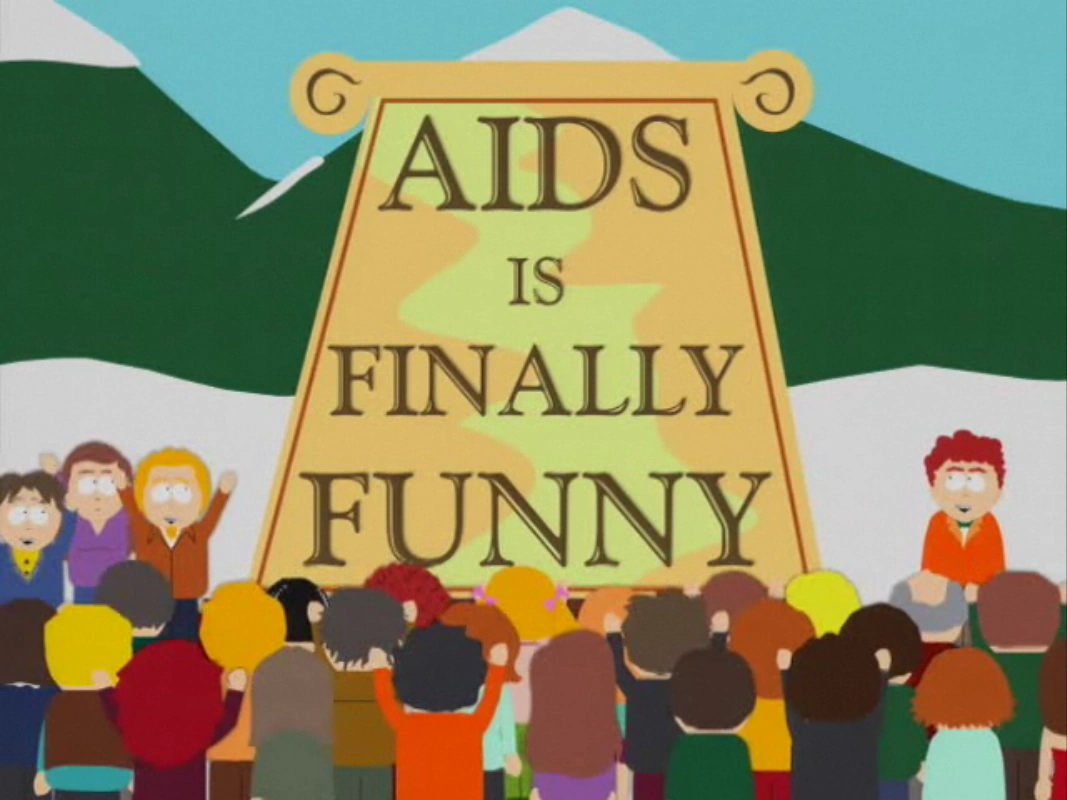
The question posed was how long it takes for something tragic to become funny. The answer, 22.3 years. At least that’s what they say on the show South Park. The episode “Jared has Aides” focuses on this quandary as the people of South Park are finally able to laugh at AIDs. At least they laughed at the miscommunication in which everyone thought Jared Fogle wanted to give children AIDs, which is made so much worse with the more recent allegations, while only wanting to pay for them to have aides. The show is focusing on the way that people, including the writers of the show, will eventually encroach on sensitive territory as people as a whole care less or have less emotion tied to these events.
Subscribe to:
Posts (Atom)